Saturday, April 23, 2011

Finishing the Run!


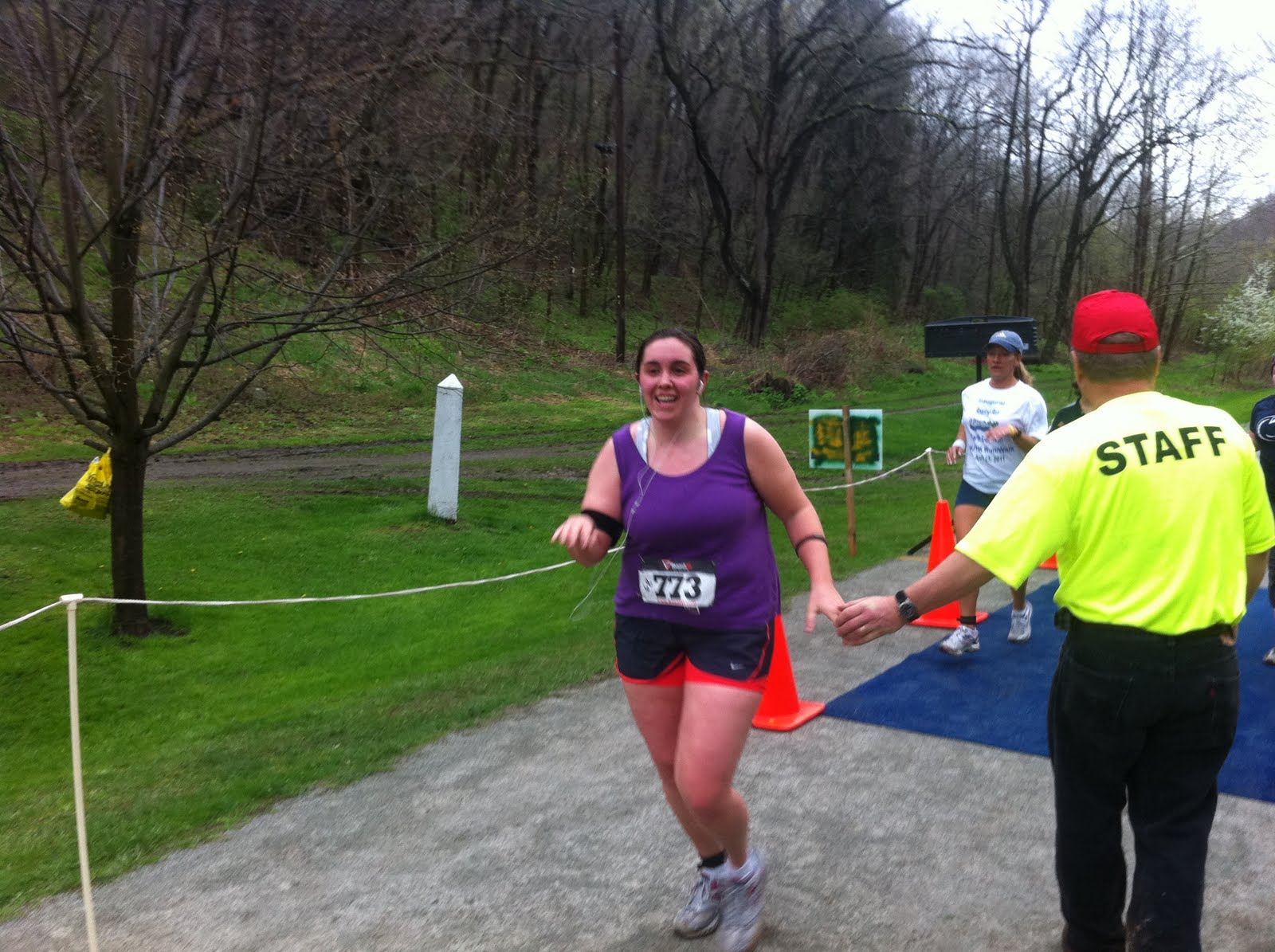
I am extremely proud of two colleagues - one a deaconess and the other someone who enjoys calling herself an F.O.D. (Friend of Deaconesses!) - who both completed a 5-Kilometer run today!
Congratulations,
Violeta and Sarah!


These women have been training for this day for months. And their training paid off. They finished the run - and with good times - 31.41 minutes and 33.13 minutes respectively. And they are smiling at the finish line!

If you will forgive me, I need to add a faith-life application while I'm at it. The timing of this 5K run is a great reminder to me of the ultimate love God has shown to the human race. Jesus Christ didn't give up in the garden when He knew that the Heavenly Father wasn't going to take the bitter cup of suffering and death away from His lips. He had become incarnate and lived as true God and true man for this very purpose. Our Savior finished the run for us. And now we rejoice in remembering His death and in preparation for a glorious celebration of His resurrection on Easter day!


A blessed Easter to all!

Wednesday, April 13, 2011

Where Do LCMS Deaconesses Serve?

The most recent information available from The Lutheran Church - Missouri Synod's Department of Rosters and Statistics shows that there are 213 deaconesses on the Synod's roster. The current "status" and "positions' of the women are described as follows:

By Roster Status:

131 – Active

24 – Candidates

22 – Non-Candidates

36 – Emeritus


By Position:

76 – Serving Member Congregation

16 – Recognized Service Organization

8 – Other Special ministry

8 – Synod HS/College/Univ/Seminary Faculty or Staff

6 – Chaplain-Institutional

5 – Synod Executive or Staff

3 – Missionary-Synod

3 – District Executive or Staff

2 – Synod College or Seminary Faculty

1 – Teacher

1 – District-Other Staff

1 – Executive Director

1 – Missionary-Other

Tuesday, February 22, 2011

12 Ways to Become a Missouri Synod Deaconess!

Anyone reading literature which is officially or unofficially associated with The Lutheran Church - Missouri Synod (LCMS), will have noted an increase in the mention of deaconesses over the last half decade. Some of this is due to the proliferation of deaconess training paths in the synod. Unless I've missed one, there are now TWELVE avenues to becoming a deaconess in the LCMS, as follows:

1. Concordia University Chicago - Undergraduate program
2. Concordia University Chicago - Certification (Cert. only, not in combination with another option listed)
3. Concordia University Chicago - on campus Master of Arts in Religion with Deaconess Certification
4. Concordia University Chicago - online Master of Arts in Religion with Deaconess Certification
5. Concordia University Chicago - Deaconess Colloquy
6. Concordia Seminary, St. Louis - Master of Arts in Deaconess Studies
7. Concordia Seminary, St. Louis - Master of Arts with Deaconess Certification
8. Center for Hispanic Studies (under Concordia Seminary, St. Louis)
9. Ethnic Immigrant Institute of Theology (under Concordia Seminary, St. Louis)
10. Deaf Institute of Theology (under Concordia Seminary St. Louis)
11. Concordia Theological Seminary, Fort Wayne - on campus Master of Arts leading to Deaconess certification
12. Concordia Theological Seminary, Fort Wayne - distance/online program, Master of Arts in Deaconess Studies

This is wonderful news, of course. But with willing workers a synod also needs places to utilize the trained workers. And at the moment finding places for all graduates, or keeping all deaconesses in the field in gainful employment is a real challenge.

The LCMS needs to do some urgent thinking about how it can work as a synod to make use of its many talented workers - whether they are deaconesses, teachers, pastors, or other commissioned ministers.

Monday, February 7, 2011

Guest Blog by Deaconess Grace Rao

Deaconess Grace Rao - who works at The Lutheran Church - Missouri Synod International Center (St. Louis) in the area of World Relief and Human Care - has been involved in some exciting diaconal education work in Africa, and very kindly agreed to provide the following guest blog:

It was a blessing and honor to visit the Lutheran Theological Seminary of Southern Africa at the request of Bishop Wilhelm Weber. I was humbled by his gracious invitation and was overwhelmed as he looked towards my unit at LCMS World Relief and Human Care to assist and uplift the seminary’s educational and diaconal needs in the areas of women and children. My first assignment was teaching an advanced course class on the “Role of Women in the Church” to the seminarian students, pastors, vicars, deans and few women from Women’s league of the Lutheran Church, with special references to “works of mercy,” the role of Lutheran deaconesses who shares the Gospel of Jesus Christ through acts of human care and mercy, and by including the structure of LCMS WR-HC and their ministries.

Second, another task was to give professional advice to the role of women in the church and specifically the inception of a deaconess program, designing the curriculum and the actual course set-up. This paved the way to lead two very successful intensive courses to train and equip local deaconesses in Southern Africa, and by teaching faithful Lutheran doctrine and practice amongst the leaders of the women’s league.

When asked for his thoughts about the diaconal training, the Bishop said “I am confident that this excellent training program will go quite a distance in assisting the Lutheran Church in Southern Africa to attain sustainable structures and staffing to address crucial works of mercy amongst previously neglected groups like single mothers, orphaned children, sufferers of HIV/Aids and other sick and dying people in and beyond the boundaries of our Lutheran congregations.” The next third and fourth courses are schedule to take place in the near future.

In addition, my responsibility also involves identifying, assessing, recommending to support the existing mercy projects, and implementing new projects as well. My unit assists a lot with theological resources. The Lord is gracious and kind, and with His blessings my ministry is moving well, and looking for stronger partnerships in years to come.

Deaconess Grace Rao

Sunday, January 30, 2011

A Quick Year


In the context of history, and particularly personal history, we often talk about how fast time flies by. When we start a new year, we can't believe how quickly the old one finished, and then at the end of January, we wonder how it could be time to begin preparing taxes again so quickly - at least those of us who need to file FAFSA forms are thinking about taxes aleady!

It was a year ago today that we attended the service and cemetery committal for my dear mother, Dorothy Violet Freitag. Throughout the year I've spent a lot of time thinking about her life and her Christian witness to me and others. I've missed her terribly, especially our daily phone calls that spanned the 3000 miles that separated us. But I've come to appreciate, also, that what she taught me is still a vital and vibrant part of my life. It's not just that I look in the mirror and see a likeness of her. Or that I bear her name as my middle name. But the faith that she and dad taught me (and my brother) is still alive and growing through the grace of God, through His Word and Sacraments.

I was particularly moved by verses 3 and 4 one of the hymns we sang in the Divine Service today: "O Savior of Our Fallen Race." The words went like this:

Remember, Lord of life and grace, How once, to save our fallen race, You put our human vesture on And came to us as Mary's Son. Alleluaia!

Today, as year by year its light bathes all the world in radiance bright, One precious truth outshines the sun: Salvation comes from You alone. Alleluia!

A blessed Epiphany!

Thursday, December 2, 2010

"Deaconess Work" Funded by German State

This year's new challenge of teaching German to Middle School students has taken me down a few unexpected paths, but certainly down some fun ones such as the exploration of German websites. On one of those journeys I came across Concordat Watch, a site dedicated to achieving the separation of Church and State as a means toward ensuring (equal) human rights for all people. Interestingly, one piece claims that "the first centralized German church charity was established by the Protestants as a response to the threat posed by the socialist workers' movement."

Among a variety of articles delivered from purely secular points of view, Concordat Watch contains (biased) information about the origin and development of deaconess work in Germany, as well as the current delivery of "Protestant" diaconal services through the organization known as Kiakonisches Werk.

Diakonisches Werk is described as presenting itself, "not as a huge state-funded corporation, but as a soup-kitchen run by deaconesses, or Protestant nuns."
These women "worked in hospitals, kindergartens, and homes for the aged. However, today the Diakonisches Werk is no longer staffed by deaconesses, any more than Caritas [the comparable Catholic charity] is by nuns."

In another entry regarding modern times we read:

The Protestant church charity, Diakonisches Werk

"The Protestant Diakonisches Werk is organized geographically into 24 state associations and thematically into 90 professional associations. It includes the diaconical institutions of nine different Protestant churches (Mennonites, Salvation Army, Independent Protestant-Lutheran Church, Methodists, Moravian Brethren, Old Catholics, Association of Free Evangelical Churches (Baptists/Bretheren), Evangelical Old-Reformed Church). ...

"In 1989 Communist rule ended in East Germany, which united with West Germany. The eastern part of the country was traditionally Protestant and it is not surprising that soon the size of the Diakonisches Werk increased significantly. Between 1978 to 1998, (a period which includes the addition of the eastern German states) the number of employees increased 70 percent (from 17,800 to 30,100) and the number of places or beds increased 51 percent, (from 713,000 to 1.08 million), while the number of full-time employees almost doubled (from 215,000 to 420,000). After this expansion into the new eastern states, consolidation set in and from 1998 to 2000 the Diakonisches Werk actually contracted slightly. The reduction in the number of facilities and services was 13 percent, employees 5 percent and places or beds 3 percent. Only the small sections concerned with “special help” and “training” showed any growth. Then from 2000 to 2002 all the key numbers rose in terms of the number of facilities and the beds or places, however, they did so only by 1.4 percent and 4 percent respectively, while the number of employees rose by 13 percent through the addition of 51,764 new positions. ...

"What is going on here? Two facts are suggestive. One is that during its quick expansion into the former East Germany, the Diakonisches Werk was obliged to hire people with no church affiliation. The second is that a decade later it was finally in a position to begin insisting on church membership and, as an official of the Diakonisches Werk admitted, to offer these employees a permanent job only when and if they joined the church."

Concordat Watch is certainly worth a look for those who might be interested in exploring cooperation between church and state in the delivery of diaconal service!

http://www.concordatwatch.eu/showsite.php?org_id=858

Saturday, November 20, 2010

Historical Records Grant provides Deaconess Photos

What a surprise and delight to note that the state of Missouri supports the preservation of historical archive materials which are related to local history but originated in the context of the work of a Christian church.

The Dana Dawson Library located at Saint Paul School of Theology, Kansas City, has received a grant from the "Missouri Historical Records Grant" program for the purpose of restoring and digitizing historical photographs from the Kansas City National Training School for Deaconesses and Missionaries. (Saint Paul School of Theology is a seminary of the United Methodist Church, split between two campuses in Kansas City and Oklahoma City.)

The library's blog site explains: "These photographs document the history of women’s ministerial work in the Kansas City community and highlight Saint Paul’s ongoing commitment to social issues. The heritage of the Kansas City National Training School is reflected in the records, photographs and publications such as The Kansas City Deaconess of the training school as well as in several books in the Saint Paul library. This rich heritage tells the story of courageous young women who ventured into the most desolate, dangerous, and poverty-stricken areas of Kansas City to bring social services and hope to the poor. Additionally, their stories give voice to the poor and immigrant populations of Kansas City during the beginning of the 20th Century. These records can supplement students’ studies in women’s history, social justice issues, health and welfare ministries, and ministry to immigrant populations."